The First Qin Emperor’s army: a royal afterlife built at scale
The famous figures near Xi’an are most revealing when read as parts of a larger burial landscape.
From king to imperial burial landscape
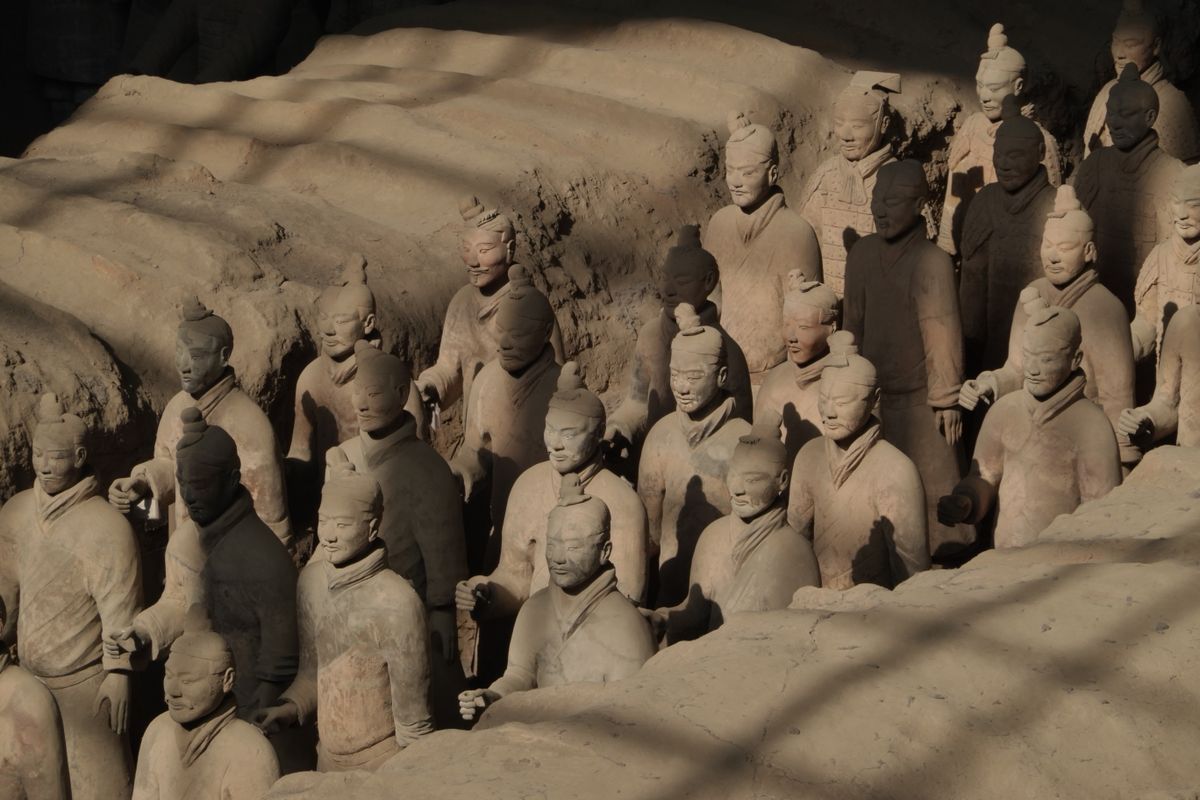
UNESCO identifies the mausoleum near Xi’an as the tomb complex of Qinshihuang, founder of the first unified Chinese empire in the third century BCE. Its account places the terracotta figures among numerous pits, structures and burial remains. This wider context is important: the soldiers are not a separate art installation but elements of a vast funerary project. The site’s significance therefore includes planning, power and the organization of labour as well as sculptural skill. Begin with a map of the complex if one is available. It will help keep the famous army connected to the broader landscape that gives it historical meaning.
Look for patterns as well as faces
Visitors often focus on the individual appearance of the figures. That is understandable, but the arrangement also deserves attention. Compare posture, equipment and position while resisting the temptation to identify every figure with a known historical person. An expressive face does not by itself establish a portrait. Ask which differences are described in museum interpretation and which are your own impressions. The exercise trains attention on both artistry and organization. It can also raise a useful question about royal power: what kind of image of service and protection was being constructed around the ruler’s burial, and how do specialists establish that interpretation from material evidence?
An excavation is not a completed revelation
Large archaeological sites change as research, conservation and public access develop. Do not assume that a popular photograph shows everything known about the complex or that every area is open. Published explanations may distinguish excavated evidence from historical descriptions of spaces that have not been fully investigated. That distinction should remain visible in a responsible article. New findings require specialist evaluation, and a dramatic headline does not automatically settle an old question. For the reader, patience is a strength: archaeological uncertainty can be part of the interest, revealing why careful excavation and conservation matter more than the speed of a spectacular announcement.
Plan for understanding, not just a photograph
Before visiting, consult the operator’s current ticket, transport and access information rather than relying on a heritage listing for practical details. Set aside time for the introductory displays and the larger site explanation. Choose one theme, such as craft production or the relationship between burial and authority, and follow it through the galleries. Afterward, read a general history of early imperial China so the emperor’s project does not stand outside its political setting. An armchair visitor can do the same with maps and catalogues. The result is a royal story that appreciates extraordinary surviving objects while asking about the institutions and people that made such a project possible.
For a family visit, ask each person to select one feature to notice carefully: footwear, hands, horses or formation. Compare observations afterwards without competing for the most dramatic discovery. This focused attention slows the visit and makes room for craft and variation, which can be overwhelmed by the first impression of extraordinary scale.
Sources & further reading
Source links support the factual context. Practical examples and suggested workflows are original editorial guidance. Sources checked October 5, 2026.
Spotted something we should correct? Send a correction. Read our editorial policy.